Ford Expedition 2018-2021 Workshop Repair Manual
|
Ford Expedition
Compatible with: All Windows Systems |
Ford Expedition
Just £9.95
Instant Download |
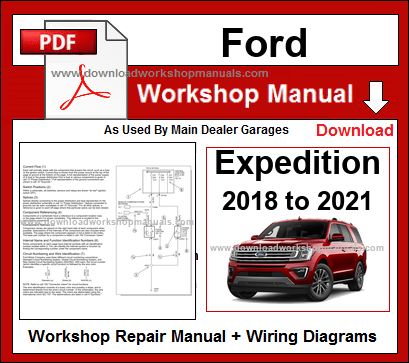
This is Ford factory service documentation for the fourth-generation Expedition, supplied as a single PDF of 11,330 pages. It is organised the way Ford organises its own workshop information — by numbered section, so 307-01 is the automatic transmission, 417-01 is exterior lighting and 501-14 is handles, locks and latches. Each procedure carries its own revision date, and the wiring content is full colour.
Which vehicles this manual fits
- Fits: Ford Expedition, fourth generation (2018 onward), including Expedition MAX. A number of wiring and seating pages also carry Lincoln Navigator content
- Covers years: 2021, 2020, 2019, 2018
- Engine options: 3.5L EcoBoost, listed throughout as 3.5L EcoBoost (272kW/370PS), including the turbocharger sections
- Gearbox: 10R80 ten-speed automatic, with the transfer case and four-wheel drive systems covered separately
- Language: English
- Pages: 11,330 in a single PDF
- File type: PDF
Inside this manual
Every entry below is a numbered Ford section present in the document:
- 100-00 General Information
- 100-02 Jacking and Lifting
- 204-00 Suspension System – General Information
- 204-01A Front Suspension – RWD
- 204-01B Front Suspension – 4WD
- 204-02 Rear Suspension
- 204-04A Wheels and Tires
- 204-04B Tire Pressure Monitoring System
- 204-05 Vehicle Dynamic Suspension
- 205-01 Driveshaft
- 205-02A Rear Drive Axle/Differential
- 205-03 Front Drive Axle/Differential
- 205-05 Rear Drive Halfshafts
- 206-00 Brake System – General Information
- 206-03 Front Disc Brake
- 206-04 Rear Disc Brake
- 206-05 Parking Brake and Actuation
- 206-06 Hydraulic Brake Actuation
- 206-07 Power Brake Actuation
- 206-09 Anti-Lock Brake System
- 206-10 Auxiliary Brake System
- 211-02 Power Steering
- 211-04 Steering Column
- 211-05 Steering Wheel and Column Electrical Components
- 303-00 Engine System – General Information
- 303-01 Engine – 3.5L EcoBoost
- 303-03 Engine Cooling – 3.5L EcoBoost
- 303-04A Fuel Charging and Controls – 3.5L EcoBoost
- 303-04B Fuel Charging and Controls – Turbocharger
- 303-06 Starting System – 3.5L EcoBoost
- 303-07 Engine Ignition – 3.5L EcoBoost
- 303-08 Engine Emission Control – 3.5L EcoBoost
- 303-12 Intake Air Distribution and Filtering
- 303-13 Evaporative Emissions
- 303-14 Electronic Engine Controls
- 307-01 Automatic Transmission – 10R80
- 307-02 Transmission Cooling
- 307-05 Automatic Transmission External Controls
- 308-07B Transfer Case
- 308-07A Four-Wheel Drive Systems
- 309-00 Exhaust System
- 310-00 Fuel System – General Information
- 412-00 Climate Control System – General Information
- 412-02 Rear Climate Control
- 413-01 Instrumentation
- 414-00 Charging System – General Information
- 414-01 Battery, Mounting and Cables
- 414-02 Generator and Regulator
- 414-05 Voltage Converter/Inverter
- 414-06 Accessory Charging
- 415-00 Information and Entertainment System
- 417-01 Exterior Lighting
- 417-02 Interior Lighting
- 418-00 Module Communications Network
- 418-01 Module Configuration
- 419-01A Perimeter Anti-Theft Alarm
- 419-01B Passive Anti-Theft System
- 419-02 Remote Convenience
- 419-03A Cruise Control
- 419-03C Collision Warning and Collision Avoidance
- 419-04 Side and Rear Vision
- 419-07 Lane Keeping System
- 419-10 Multifunction Electronic Modules
- 501-00 Body System – General Information
- 501-02 Front End Body Panels
- 501-03 Body Closures
- 501-05 Interior Trim and Ornamentation
- 501-08 Exterior Trim and Ornamentation
- 501-09 Rear View Mirrors
- 501-10A Front Seats
- 501-10B Second Row Seats
- 501-10C Third Row Seats
- 501-11 Glass, Frames and Mechanisms
- 501-12 Instrument Panel and Console
- 501-14 Handles, Locks, Latches and Entry Systems
- 501-16 Wipers and Washers
- 501-17 Roof Opening Panel
- 501-19 Bumpers
- 501-20A Seatbelt Systems
- 501-20B Supplemental Restraint System
- 501-25 Body Repairs – General Information
- 501-28 Roof Sheet Metal Repairs
- 501-29 Side Panel Sheet Metal Repairs
- 501-30 Rear End Sheet Metal Repairs
- 502-02 Full Frame and Body Mounting
Sample pages from this manual
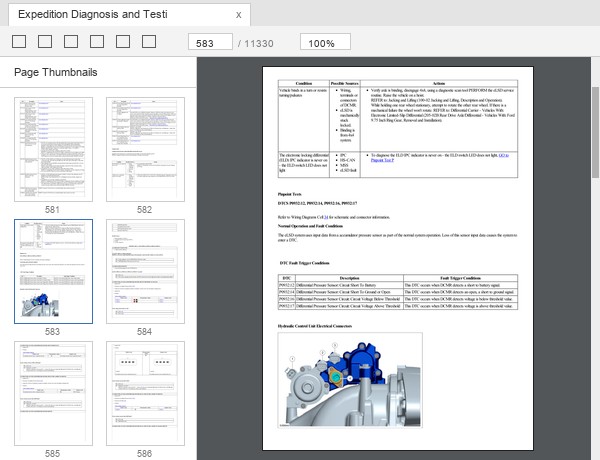
These are real pages taken from the document:
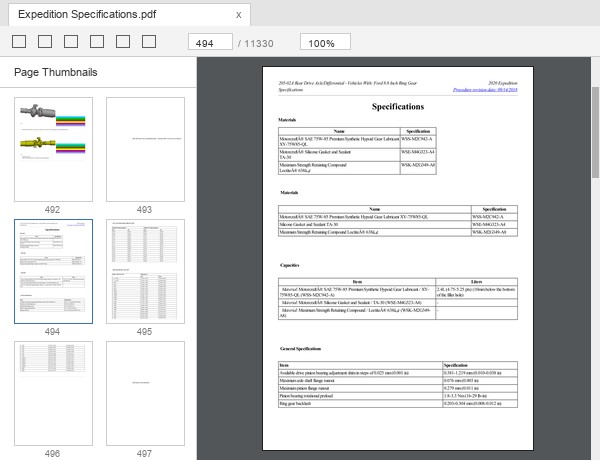
What you can repair with it
Powertrain work centres on the 3.5L EcoBoost and the 10R80 ten-speed automatic. The transmission section is the most heavily referenced in the whole document and includes the Adaptive Learning Drive Cycle as a general procedure, so a rebuild or valve body job can be finished properly rather than left to relearn on its own. Turbocharger, fuel charging, intake air and evaporative emissions each have their own section.
Chassis coverage separates front suspension into rear-wheel drive and four-wheel drive versions, and adds Vehicle Dynamic Suspension for air-sprung cars — including the Ride Height Calibration routine that has to be run after replacing a suspension height sensor. Brakes run from general information through front and rear discs, hydraulic and power actuation, anti-lock control and the auxiliary brake system.
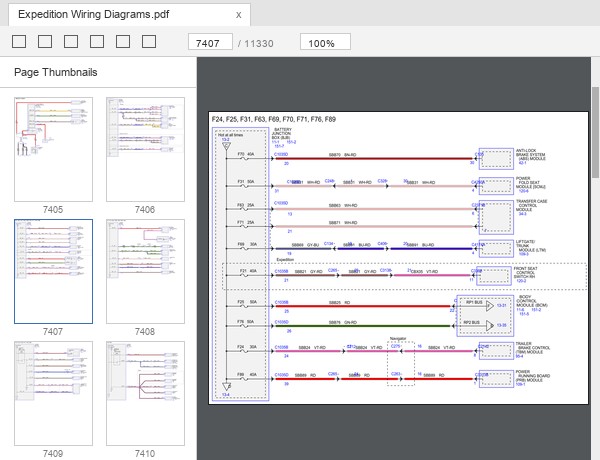
Electrical work is where the page count goes. Module Communications Network and Multifunction Electronic Modules are both large sections, backed by full colour power distribution diagrams that show fuse numbers, circuit identifiers and wire colours down to each destination module. Driver assistance is covered too — lane keeping, side and rear vision, collision warning and the parking aid variants. Body repair extends to roof, side panel and rear end sheet metal work with tolerance checking.
Manual language and format
This manual is written in English and downloads as a single PDF. It carries a text layer, so you can search it for a section number, a circuit identifier or a torque figure and jump straight there rather than paging through it. It opens on Windows and Mac computers, tablets and phones, and individual pages print normally.
Questions about this manual
How do I reset the air suspension system?
With a scan tool, using the Ride Height Calibration routine. The manual calls for it in several places — after replacing a suspension height sensor, after work on the Vehicle Dynamic Module, and as the closing step of several suspension procedures — and the instruction is to connect the scan tool, run Ride Height Calibration and follow the tool's directions. The Vehicle Dynamic Suspension section covers the sensors, the air springs and the module behind it.
How do you reset a Ford transmission's adaptive learning?
By running the Adaptive Learning Drive Cycle, which is a general procedure inside the 10R80 automatic transmission section. Where a repair also requires new software, the manual pairs it with a transmission strategy download and then the drive cycle, and it tells you which repairs need both. This is the step that determines whether shift quality settles down after a transmission job.
Why is my Ford Expedition so bouncy?
The suspension section diagnoses ride complaints by symptom rather than by guesswork. “Rough or harsh ride”, “vehicle leans to” one side and squeak, creak or rattle noises from the front or rear suspension each have their own entry listing the possible sources and the action to take, and air-sprung cars are separated from conventionally sprung ones so you are not chasing a fault in the wrong system.
Which model years does this manual cover?
It is Ford's workshop information for the fourth-generation Expedition, which ran from 2018 to 2021 with the same 3.5L EcoBoost engine and 10R80 transmission throughout. The document itself is the 2020 model year edition — its page headers read “2020 Expedition” — and individual procedures carry revision dates running from 2012 to 2020.
Which engine and gearbox are covered?
The 3.5L EcoBoost, named throughout as 3.5L EcoBoost (272kW/370PS), and the 10R80 ten-speed automatic. The transfer case and four-wheel drive systems are documented in their own sections, so both rear-wheel drive and four-wheel drive cars are served.
Are wiring diagrams included?
Yes, in full colour. The power distribution diagrams show the battery junction box and each fuse by number, the circuit identifier and wire colour on every branch, and the destination module for each feed — anti-lock brakes, body control, transfer case, trailer brake control and so on. The first sample page above is one of them.
How you receive it
Payment is processed securely and the download link is issued immediately afterwards, so there is nothing to wait for and nothing shipped. The file is yours to keep and re-download within the link period.